defense mechanisms serve what purpose according to freud and psychoanalytic theory?
| | This article is missing information about scientific status and criticism of validity. (January 2020) |

In psychoanalytic theory, a defence mechanism (American English language: defense force mechanism), is an unconscious psychological performance that functions to protect a person from anxiety-producing thoughts and feelings related to internal conflicts and outer stressors.[i] [two] [iii]
Defence force mechanisms may result in healthy or unhealthy consequences depending on the circumstances and frequency with which the mechanism is used.[4] Defence mechanisms (German: Abwehrmechanismen) are psychological strategies brought into play by the unconscious mind[5] to manipulate, deny, or distort reality in order to defend against feelings of feet and unacceptable impulses and to maintain ane's self-schema or other schemas.[six] These processes that manipulate, deny, or misconstrue reality may include the following: repression, or the burying of a painful feeling or idea from one's sensation even though information technology may resurface in a symbolic class;[4] identification, incorporating an object or idea into oneself;[7] and rationalization, the justification of one's behaviour and motivations by substituting "skillful" acceptable reasons for the actual motivations.[4] [8] In psychoanalytic theory, repression is considered the basis for other defense mechanisms.[4]
Healthy people normally apply different defence mechanisms throughout life. A defence mechanism becomes pathological merely when its persistent use leads to maladaptive behaviour such that the physical or mental health of the individual is adversely afflicted. Amidst the purposes of ego defense force mechanisms is to protect the listen/self/ego from anxiety or social sanctions or to provide a refuge from a situation with which one cannot currently cope.[9]
I resource used to evaluate these mechanisms is the Defense Style Questionnaire (DSQ-twoscore).[10] [11]
Theories and classifications [edit]
Dissimilar theorists have different categorizations and conceptualizations of defence mechanisms. Big reviews of theories of defence force mechanisms are bachelor from Paulhus, Fridhandler and Hayes (1997)[12] and Cramer (1991).[13] The Journal of Personality published a special issue on defence mechanisms (1998).[14]
In the first definitive book on defence mechanisms, The Ego and the Mechanisms of Defence force (1936),[15] Anna Freud enumerated the ten defence mechanisms that announced in the works of her male parent, Sigmund Freud: repression, regression, reaction formation, isolation, undoing, projection, introjection, turning against i's own person, reversal into the opposite, and sublimation or deportation.[16]
Sigmund Freud posited that defence mechanisms work by distorting id impulses into adequate forms, or by unconscious or conscious blockage of these impulses.[xv] Anna Freud considered defense mechanisms every bit intellectual and motor automatisms of diverse degrees of complexity, that arose in the process of involuntary and voluntary learning.[17]
Anna Freud introduced the concept of indicate anxiety; she stated that it was "not direct a conflicted instinctual tension but a betoken occurring in the ego of an predictable instinctual tension".[fifteen] The signalling role of feet was thus seen as crucial, and biologically adapted to warn the organism of danger or a threat to its equilibrium. The feet is felt as an increment in bodily or mental tension, and the betoken that the organism receives in this way allows for the possibility of taking defensive action regarding the perceived danger.
Both Freuds studied defence mechanisms, but Anna spent more of her time and research on five primary mechanisms: repression, regression, projection, reaction germination, and sublimation. All defense force mechanisms are responses to anxiety and how the consciousness and unconscious manage the stress of a social state of affairs.[18]
- Repression: when a feeling is hidden and forced from the consciousness to the unconscious because it is seen equally socially unacceptable
- Regression: falling back into an early on land of mental/physical development seen as "less demanding and safer"[18]
- Projection: possessing a feeling that is accounted every bit socially unacceptable and instead of facing it, that feeling or "unconscious urge" is seen in the actions of other people[xviii]
- Reaction formation: acting the contrary way that the unconscious instructs a person to deport, "oftentimes exaggerated and obsessive". For case, if a wife is infatuated with a human who is not her husband, reaction formation may cause her to – rather than crook – become obsessed with showing her married man signs of love and affection.[18]
- Sublimation: seen as the well-nigh acceptable of the mechanisms, an expression of anxiety in socially adequate ways[18]
Otto F. Kernberg (1967) adult a theory of borderline personality organization of which one event may be deadline personality disorder. His theory is based on ego psychological object relations theory. Borderline personality organization develops when the kid cannot integrate helpful and harmful mental objects together. Kernberg views the utilise of primitive defense mechanisms as central to this personality arrangement. Archaic psychological defences are projection, denial, dissociation or splitting and they are called borderline defence mechanisms. Also, devaluation and projective identification are seen every bit borderline defences.[19]
In George Eman Vaillant's (1977) categorization, defences form a continuum related to their psychoanalytical developmental level.[20] [ non-primary source needed ] They are classified into pathological, immature, neurotic and "mature" defences.
Robert Plutchik's (1979) theory views defences equally derivatives of basic emotions, which in turn relate to particular diagnostic structures. According to his theory, reaction formation relates to joy (and manic features), denial relates to acceptance (and histrionic features), repression to fear (and passivity), regression to surprise (and deadline traits), compensation to sadness (and depression), projection to disgust (and paranoia), displacement to acrimony (and hostility) and intellectualization to anticipation (and obsessionality).[21]
The Diagnostic and Statistical Transmission of Mental Disorders (DSM-Iv) published by the American Psychiatric Association (1994) includes a tentative diagnostic axis for defence mechanisms.[22] This classification is largely based on Vaillant's hierarchical view of defences, but has some modifications. Examples include: denial, fantasy, rationalization, regression, isolation, projection, and deportation.
Vaillant'due south categorization [edit]
Psychiatrist George Eman Vaillant introduced a four-level classification of defence mechanisms:[23] [24] Much of this is derived from his observations while overseeing the Grant study that began in 1937 and is on-going. In monitoring a group of men from their freshman year at Harvard until their deaths, the purpose of the study was to meet longitudinally what psychological mechanisms proved to have impact over the course of a lifetime. The hierarchy was seen to correlate well with the chapters to adapt to life. His most comprehensive summary of the on-going study was published in 1977.[25]The focus of the study is to define mental wellness rather than disorder.
- Level I – pathological defences (psychotic denial, delusional projection)
- Level Ii – young defences (fantasy, projection, passive aggression, acting out)
- Level Iii – neurotic defences (intellectualization, reaction formation, dissociation, displacement, repression)
- Level Iv – mature defences (sense of humour, sublimation, suppression, altruism, anticipation)
Level 1: pathological [edit]
When predominant, the mechanisms on this level are almost always severely pathological. These defences, in conjunction, allow one effectively to rearrange external experiences to eliminate the need to cope with reality. Pathological users of these mechanisms frequently appear irrational or insane to others. These are the "pathological" defences, common in overt psychosis. Nonetheless, they are normally establish in dreams and throughout childhood too.[26] They include:
- Delusional projection: Delusions about external reality, usually of a persecutory nature
- Denial: Refusal to accept external reality considering it is likewise threatening; arguing against an anxiety-provoking stimulus by stating it does not exist; resolution of emotional conflict and reduction of feet past refusing to perceive or consciously acknowledge the more unpleasant aspects of external reality
- Distortion: A gross reshaping of external reality to run across internal needs
Level ii: young [edit]
These mechanisms are often present in adults. These mechanisms lessen distress and anxiety produced by threatening people or by an uncomfortable reality. Excessive utilize of such defences is seen as socially undesirable, in that they are immature, difficult to deal with and seriously out of touch with reality. These are the so-called "young" defences and overuse nigh ever leads to serious problems in a person's power to cope finer. These defences are ofttimes seen in major depression and personality disorders.[26] They include:
- Acting out: Straight expression of an unconscious wish or impulse in action, without witting awareness of the emotion that drives the expressive behavior
- Hypochondriasis: An excessive preoccupation or worry about having a serious disease
- Passive-ambitious behavior: Indirect expression of hostility
- Projection: A primitive form of paranoia. Project reduces anxiety by allowing the expression of the undesirable impulses or desires without condign consciously aware of them; attributing one's own unacknowledged, unacceptable, or unwanted thoughts and emotions to another; includes severe prejudice and jealousy, hypervigilance to external danger, and "injustice collecting", all with the aim of shifting one'southward unacceptable thoughts, feelings and impulses onto someone else, such that those same thoughts, feelings, behavior and motivations are perceived as beingness possessed by the other.
- Schizoid fantasy: Tendency to retreat into fantasy in order to resolve inner and outer conflicts
Level 3: neurotic [edit]
These mechanisms are considered neurotic, but adequately mutual in adults. Such defences have short-term advantages in coping, but can oftentimes cause long-term problems in relationships, work and in enjoying life when used equally one's primary manner of coping with the world.[26] They include:
- Deportation: Defence machinery that shifts sexual or ambitious impulses to a more acceptable or less threatening target; redirecting emotion to a safer outlet; separation of emotion from its real object and redirection of the intense emotion toward someone or something that is less offensive or threatening in order to avoid dealing directly with what is frightening or threatening.
- Dissociation: Temporary desperate modification of one's personal identity or grapheme to avoid emotional distress; separation or postponement of a feeling that normally would accompany a state of affairs or thought.
- Intellectualization: A form of isolation; concentrating on the intellectual components of a situation and so every bit to distance oneself from the associated feet-provoking emotions; separation of emotion from ideas; thinking about wishes in formal, affectively banal terms and not interim on them; avoiding unacceptable emotions by focusing on the intellectual aspects (solitude, rationalization, ritual, undoing, compensation, and magical thinking)
- Reaction formation: Converting unconscious wishes or impulses that are perceived to be unsafe or unacceptable into their opposites; behaviour that is completely the reverse of what one really wants or feels; taking the opposite conventionalities because the truthful belief causes feet
- Repression: The procedure of attempting to repel desires towards pleasurable instincts, acquired past a threat of suffering if the want is satisfied; the desire is moved to the unconscious in the attempt to foreclose information technology from entering consciousness;[27] seemingly unexplainable naivety, memory lapse or lack of awareness of ane'southward own situation and condition; the emotion is conscious, just the idea behind it is absent[28]
Level 4: mature [edit]
These are commonly found among emotionally healthy adults and are considered mature, even though many have their origins in an immature stage of development. They are conscious processes, adapted through the years in gild to optimise success in human society and relationships. The use of these defences enhances pleasure and feelings of control. These defences assist to integrate conflicting emotions and thoughts, whilst still remaining effective. Those who utilise these mechanisms are usually considered virtuous.[26] Mature defences include:
- Altruism: Constructive service to others that brings pleasure and personal satisfaction
- Anticipation: Realistic planning for future discomfort
- Humour: Overt expression of ideas and feelings (especially those that are unpleasant to focus on or besides terrible to talk virtually direct) that gives pleasure to others. The thoughts retain a portion of their innate distress, but they are "skirted around" past witticism, for example, cocky-deprecation.
- Sublimation: Transformation of unhelpful emotions or instincts into healthy deportment, behaviours, or emotions; for example, playing a heavy contact sport such as football or rugby can transform aggression into a game[29]
- Suppression: The conscious decision to delay paying attention to a idea, emotion, or need in guild to cope with the present reality; making information technology possible later on to access uncomfortable or lamentable emotions whilst accepting them
Other defence mechanisms [edit]
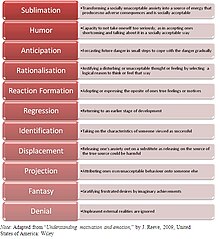
Diagram of selected ego defence mechanisms
Pathological [edit]
- Conversion: The expression of an intrapsychic conflict equally a concrete symptom; examples include blindness, deafness, paralysis, or numbness. This phenomenon is sometimes called hysteria.[30]
- Splitting: A archaic defense. Both harmful and helpful impulses are separate off and segregated, often projected onto someone else. The defended individual segregates experiences into all-practiced and all-bad categories, with no room for ambivalence and ambivalence. When "splitting" is combined with "projecting", the undesirable qualities that one unconsciously perceives oneself as possessing, one consciously attributes to some other.[31]
Young [edit]
- Idealization: Tending to perceive another individual as having more desirable qualities than they may actually take.[32]
- Introjection: Identifying with some idea or object so securely that it becomes a function of that person. For example, introjection occurs when we take on attributes of other people who seem better able to cope with the state of affairs than we do.
- Projective identification: The object of projection invokes in that person a version of the thoughts, feelings or behaviours projected.
- Somatization: The transformation of uncomfortable feelings towards others into uncomfortable feelings toward oneself: pain, affliction, and anxiety.
- Wishful thinking: Making decisions according to what might exist pleasing to imagine instead of past appealing to evidence, rationality, or reality.
Neurotic [edit]
- Isolation: Separation of feelings from ideas and events, for case, describing a murder with graphic details with no emotional response.
- Rationalization (making excuses): Convincing oneself that no wrong has been done and that all is or was all right through faulty and false reasoning. An indicator of this defense mechanism tin can be seen socially as the formulation of user-friendly excuses.
- Regression: Temporary reversion of the ego to an earlier stage of development rather than handling unacceptable impulses in a more than adult way, for case, using whining as a method of communicating despite already having acquired the power to speak with an appropriate level of maturity.[29]
- Undoing: A person tries to 'undo' an unhealthy, destructive or otherwise threatening thought past acting out the reverse of the unacceptable. Involves symbolically nullifying an unacceptable or guilt provoking thought, thought, or feeling by confession or atonement.
- Upward and down social comparisons: A defensive trend that is used equally a means of self-evaluation. Individuals will expect to another individual or comparison grouping who are considered to be worse off in social club to dissociate themselves from perceived similarities and to make themselves feel better about themselves or their personal situation.
- Withdrawal: Avoidance is a grade of defence. It entails removing oneself from events, stimuli, and interactions nether the threat of being reminded of painful thoughts and feelings.
Relation with coping [edit]
![[icon]](https://upload.wikimedia.org/wikipedia/commons/thumb/1/1c/Wiki_letter_w_cropped.svg/20px-Wiki_letter_w_cropped.svg.png) | This section needs expansion. You can help by adding to it. (August 2016) |
At that place are many dissimilar perspectives on how the construct of defence relates to the construct of coping; some writers differentiate the constructs in various ways, simply "an important literature exists that does not make any difference between the 2 concepts".[33] In at least one of his books, George Eman Vaillant stated that he "volition apply the terms adaptation, resilience, coping, and defence force interchangeably".[34]
See also [edit]
- Coherence therapy § Symptom coherence
- Cognitive dissonance – Stress from contradictory beliefs
- Experiential avoidance – Attempts to avoid internal experiences
- List of cognitive biases – Systematic patterns of deviation from norm or rationality in judgment
- List of maladaptive schemas – Listing on psychotherapy topic
- Motivated forgetting
- Motivated reasoning – Using emotionally-biased reasoning to produce justifications or make decisions
- Narcissistic defences – Mental processes which preserve the self
- Psychological resistance – Miracle in clinical psychology
- Self-enhancement – Type of motivation
References [edit]
- ^ Di Giuseppe M., Perry J.C., Conversano C., Gelo O.C.G., Gennaro A. Defense mechanisms, gender, and adaptiveness in emerging personality disorders in adolescent outpatients. J. Nerv. Ment. Dis.. 2020;208(12):933-941. doi:10.1097/NMD.0000000000001230
- ^ American Psychiatric Association (1994). Diagnostic and statistical manual of mental disorders (4th ed.). Washington, DC: American Psychiatric Press
- ^ Schacter, Daniel 50. (2011). Psychology (ii ed.). New York: Worth Publishers. pp. 482–483]. ISBN978-ane-4292-3719-2.
- ^ a b c d Utah Psych. "Defence force Mechanisms" 2010. Retrieved on 05 October 2013.
- ^ Defence+Mechanisms at the United states National Library of Medicine Medical Field of study Headings (MeSH)
- ^ "archive of: www.3-S.us What is a self-schema?". Info.med.yale.edu. Archived from the original on February 4, 2013. Retrieved 2013-05-05 .
- ^ Chalquist, Craig. "A Glossary of Freudian Terms" 2001. Retrieved on 05 October 2013.
- ^ Correspondent: GeorgeT (15 November 2007). "Top 7 Psychological Defense Mechanisms". Listverse. Retrieved 2013-05-05 .
- ^ "defence mechanisms -- Britannica Online Encyclopedia". www.britannica.com. Retrieved 2008-03-11 .
- ^ Ruuttu T, Pelkonen One thousand, Holi K, et al. (February 2006). "Psychometric properties of the defence fashion questionnaire (DSQ-40) in adolescents". J. Nerv. Ment. Dis. 194 (2): 98–105. doi:10.1097/01.nmd.0000198141.88926.2e. PMID 16477187. S2CID 23537135.
- ^ Hovanesian Due south, Isakov I, Cervellione KL (2009). "Defense mechanisms and suicide risk in major depression". Arch Suicide Res. thirteen (one): 74–86. doi:x.1080/13811110802572171. PMID 19123111. S2CID 205804843.
- ^ Paulhus, D.L., Fridhandler B., and Hayes S. (1997). Psychological defense: Contemporary theory and research. In Briggs, Stephen; Hogan, Robert Goode; Johnson, John W. (1997). Handbook of personality psychology. Boston: Academic Press. pp. 543–579. ISBN978-0-12-134646-i.
- ^ Cramer, P. (1991). The Evolution of Defense Mechanisms: Theory, Research, and Assessment. New York, Springer-Verlag.
- ^ Special effect [on defence mechanisms], Periodical of Personality (1998), 66 (6): 879–1157
- ^ a b c Freud, A. (1937). The Ego and the Mechanisms of Defence, London: Hogarth Printing and Constitute of Psycho-Assay. (Revised edition: 1966 (US), 1968 (Uk))
- ^ Lipot Szondi (1956) Ego Analysis Ch. Nineteen, translated by Arthur C. Johnston, p. 268
- ^ Romanov, East.S. (1996). Mechanisms of psychological defense: genesis, performance, diagnostics.
- ^ a b c d e Hock, Roger R. "Reading 30: You're Getting Defensive Again!" Forty Studies That Changed Psychology. 7th ed. Upper Saddle River: Pearson Education, 2013. 233–38. Print.
- ^ Kernberg O (July 1967). "Borderline personality organization". J Am Psychoanal Assoc. xv (three): 641–85. doi:ten.1177/000306516701500309. PMID 4861171. S2CID 32199139.
- ^ Vaillant, George E. (1977). Adaptation to life . Boston: Little, Chocolate-brown. ISBN978-0-316-89520-0.
- ^ Plutchik, R., Kellerman, H., & Conte, H. R. (1979). A structural theory of ego defences and emotions. In C. E. Izard (Ed.), Emotions in personality and psychopathology (pp. 229–-257). New York: Plenum Printing.
- ^ American Psychiatric Clan. (1994). Diagnostic and statistical manual of mental disorders (quaternary ed.). Washington, DC: Author.
- ^ Cramer, Phebe (May 2006). Protecting the Self. The Guilford Press. p. 17. ISBN9781593855284.
- ^ Vaillant, George (1994). "Ego mechanisms of defense force and personality psychopathology" (PDF). Journal of Abnormal Psychology. 103 (i): 44–50. doi:10.1037/0021-843X.103.1.44. PMID 8040479.
- ^ Vailant, George (1977). Adaptation to Life. Boston: Little Dark-brown. ISBN0-316-89520-2.
- ^ a b c d Vaillant, G. East., Bond, G., & Vaillant, C. O. (1986). An empirically validated bureaucracy of defence mechanisms. Archives of General Psychiatry, 73, 786–794. George Eman Valillant
- ^ Laplanche pp. 390, 392[ full citation needed ]
- ^ Psychological Defenses from DSM-IV (see Repression), Virginia Democracy University. Retrieved on December 12, 2014.
- ^ a b Schacter, Gilbert, Wegner (2011), Psychology (2nd edition), Worth Publishers, p. 483
- ^ Carlson, Neil R.. "Chapter fourteen." Psychology: the science of behaviour. 4th Canadian Edition ed. Toronto, Ont.: Pearson Pedagogy Canada Inc., 2010. 456. Impress.
- ^ McWilliams, Nancy (2011). Psychoanalytic Diagnosis: Understanding Personality Structure in the Clinical Process, 2d Edition. New York, NY: The Guilford Printing. pp. 60, 63, 103. ISBN978-1609184940.
- ^ Vaillant, George Eman (1992). Ego Mechanisms of Defense force: A Guide for Clinicians and Researchers. American Psychiatric Publishing. p. 238. ISBN978-0-88048-404-vi.
- ^ Kramer, Ueli (June 2010). "Coping and defense force mechanisms: What's the difference? - Second deed". Psychology and Psychotherapy: Theory, Research and Practice. 83 (Pt 2): 207–221. doi:ten.1348/147608309X475989. PMID 19883526.
- ^ Vaillant, George Eastward. (2012). Triumphs of experience: the men of the Harvard Grant Study. Cambridge, MA: Belknap Press of Harvard University Press. p. 262. doi:10.4159/harvard.9780674067424. ISBN9780674059825. OCLC 792887462.
External links [edit]
-
 Media related to Defence mechanisms at Wikimedia Eatables
Source: https://en.wikipedia.org/wiki/Defence_mechanism
0 Response to "defense mechanisms serve what purpose according to freud and psychoanalytic theory?"
Post a Comment